

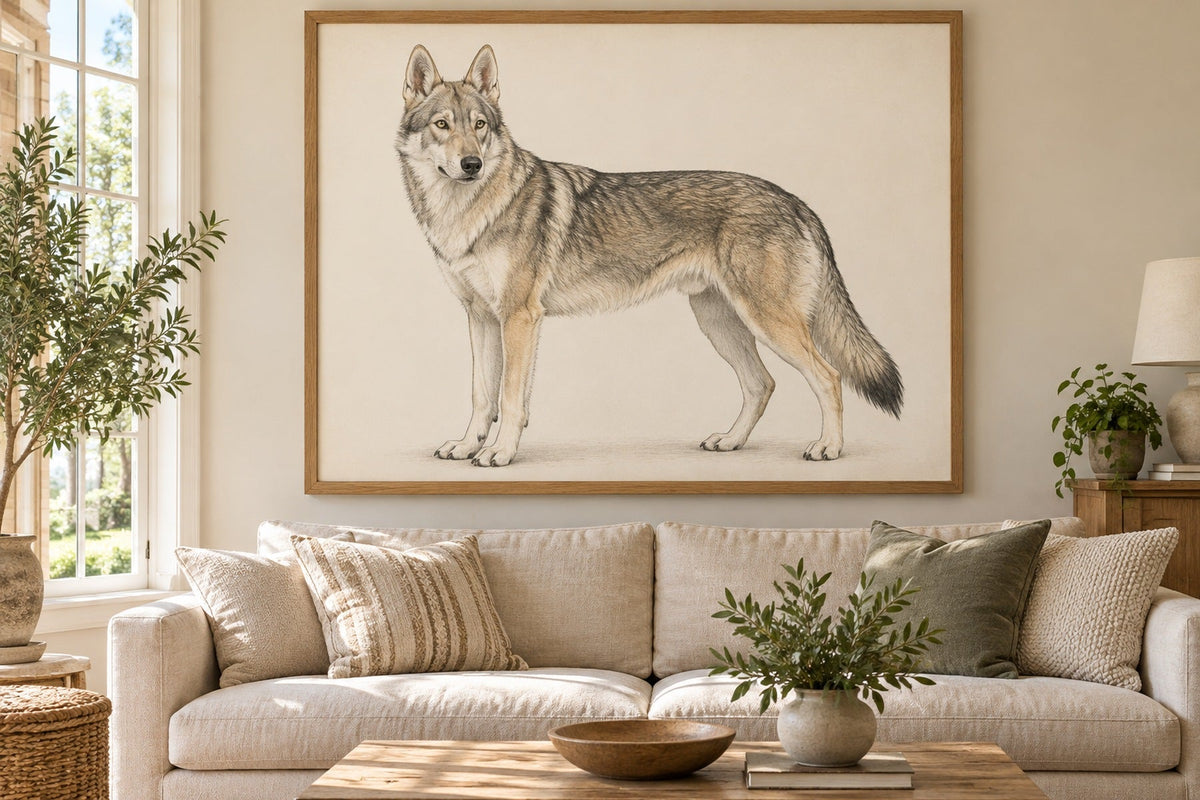
Leendert Saarloos wanted to make the German Shepherd a better working dog and crossed it with a female wolf. The result, as the FCI standard openly admits, was a dog with little aptitude for working roles. Instead, the Saarloos Wolfhond (Saarlooswolfhond) gained more natural traits that owners must accommodate in daily life.
| FCI | Group 1 (Sheepdogs and Cattledogs), Section 1 Sheepdogs, Standard No. 311 Saarlooswolfhond (Saarlooswolfhund), without working trial |
|---|---|
| Country of origin | Netherlands |
| Size (height at the withers) | Males 65 to 75 cm, females 60 to 70 cm; slightly greater height allowed |
| Weight | not specified in the FCI standard |
| Life expectancy | no reliable study figure found (N/A) |
| Coat | double coat; undercoat predominates in winter, forming a distinct collar, while outer hair dominates in summer |
| Colours in the standard | light to dark black-shaded game colour (wolf grey) or brown-shaded game colour; pale wolf markings from cream white to white; expressive mask |
An experiment with wolf blood
The standard says Saarloos (1884 to 1969) paired the German Shepherd male Gerard van der Fransenum with the female wolf Fleuri. Backcrossing to the father produced animals with a quarter wolf ancestry. Some initially worked as guide dogs, but further wolf ancestry removed this aptitude. The breed was recognised in the Netherlands in 1975 and named after its founder; definitive FCI recognition followed in 1981. Its younger relative is the Czechoslovakian Wolfdog.
Obedience at its own discretion
Lively, energetic and proudly independent, says the standard, known for obeying mainly of its own free will. It is very affectionate towards its people and reserved with strangers. Avoiding unfamiliar situations is typical. Daily life therefore demands patience when introducing cities, visitors and new places, and a recall you never trust blindly.
A trotter for long distances
The standard describes an enduring, light-footed trot that scarcely tires it. Long hikes together at its own pace suit it better than ball games or rapid instructions. No specific working use was ever its breeding aim; it is a companion and house dog.
Winter fur and summer coat
It develops dense undercoat in autumn and loses large quantities in spring. Brush several times weekly then; a weekly session suffices otherwise.
A small population, two documented issues
The breed is numerically very small. Among 239 healthy breeding dogs, 75 carried the variant for dwarfism caused by an LHX3 gene change, or 31 per cent (Voorbij et al. 2014). Genetic testing therefore belongs before every pairing; ask for the parents’ results when buying a puppy. A Dutch study estimates epilepsy prevalence at 1,9 per cent, above the general dog figure of 0,6 to 0,75 per cent; prevalence declined over the years (Rolink et al. 2026). No reliable lifespan study exists.
Who might suit a Saarloos
Calm, experienced people with plenty of time, seeking to understand wolf-like behaviour rather than reshape it. A house with a secure garden and surroundings without constant bustle help greatly.
Who is less suited
First-time owners, busy lifestyles and people seeking a reliably obedient dog for training classes and cafés. Those who often leave it alone are unlikely to be happy with it.

Before welcoming a dog with so much independence, take an honest look at the breed quiz and our book “Welcher Hund passt WIRKLICH zu dir?” (book in German). For the early days with a puppy, there is the free Puppy Starter Pack. If your Saarloos already lives with you, find it among our dog portraits or as a digital artwork to download.
Further reading
- Siberian Husky: why so many end up in shelters at two years old
- The socialisation period: why “as much as possible” is the wrong advice
- Leaving your dog alone: learning without drama (step by step)
Sources, accessed on 20.10.2026: FCI-Standard Nr. 311 Saarlooswolfhond (fci.be, German version dated 09.03.2017; original language English, English version dated 29.05.2015); Voorbij AM et al., Pituitary dwarfism in Saarloos and Czechoslovakian wolfdogs is associated with a mutation in LHX3, J Vet Intern Med 2014; Rolink T et al., Phenotypic characterisation, quality of life and prevalence of idiopathic epilepsy and epilepsy of unknown cause in the nine Dutch dog breeds, Frontiers in Veterinary Science 2026; McMillan KM et al., Longevity of companion dog breeds, Scientific Reports 2024.
The links to our books are affiliate links. Buying through them supports us at no extra cost to you.


