

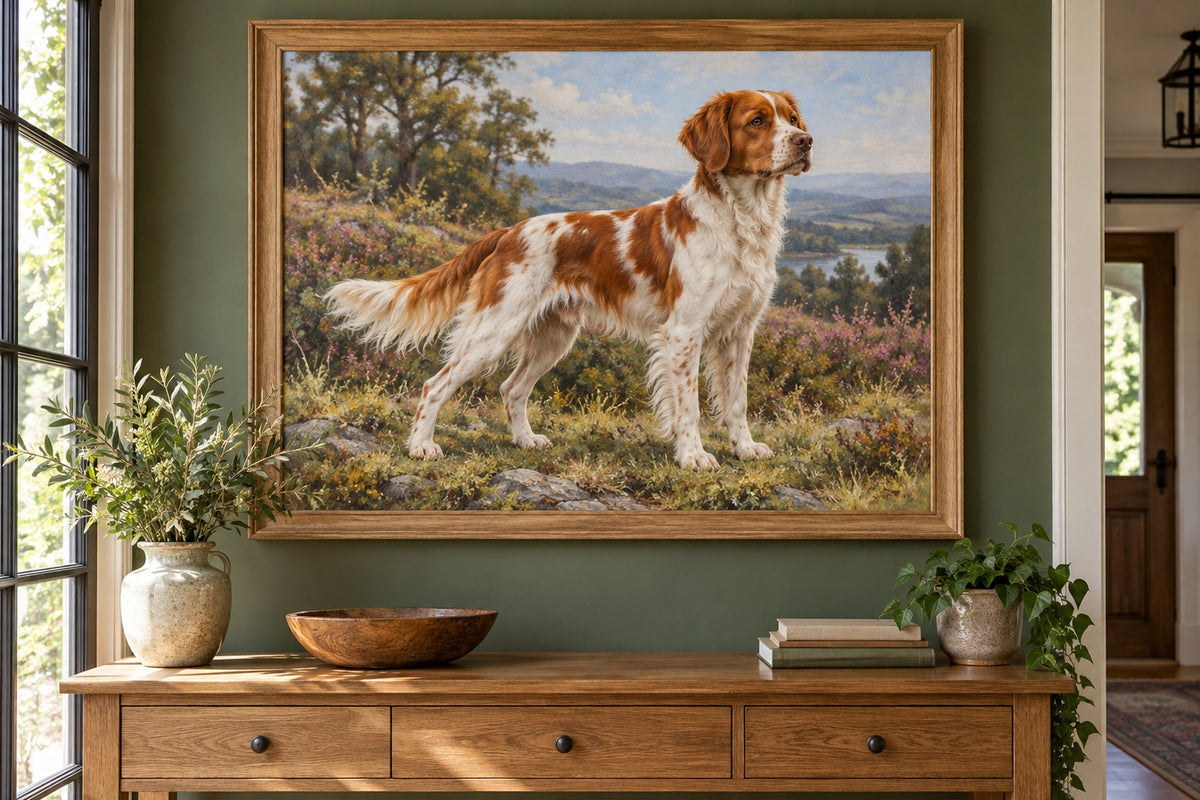
The first breed club for the Brittany Spaniel (Epagneul Breton) put its distinctive feature right in its name: the club for the Epagneul Breton with a naturally short tail. Many puppies are still born with a bobtail or no tail at all. A Norwegian study shows this is more than an outward detail.
| FCI | Group 7 (Pointing Dogs), Section 1.2 Continental Pointing Dogs, spaniel type, Standard No. 95, with working trial |
|---|---|
| Country of origin | France |
| Size (height at the withers) | Males 48 to 51 cm, females 47 to 50 cm, each with 1 cm tolerance; ideal males 49 to 50 cm, females 48 to 49 cm |
| Weight | not specified in the FCI standard |
| Life expectancy | median 11,1 years in a British analysis of 584.734 dogs (McMillan et al. 2024), listed there as Brittany |
| Coat | fine on the body, not silky, flat or very slightly wavy, never curly; short on head and fronts of legs, generous feathering behind legs |
| Colours in the standard | white-orange, white-black or white-brown with irregular patches, piebald, roan or ticked on the nose bridge, lips and legs; tricolour with tan; narrow blaze desirable, solid colour not permitted |
From central Brittany
According to the standard, the breed comes from central Brittany and is probably one of the oldest spaniel-type pointing dogs. Selection and crossings shaped it from the beginning of the 20th century; the first standard was drafted in Nantes in 1907 and adopted in 1908. Genetic analyses show a distinct maternal lineage in the Epagneul Breton (Parra et al. 2008).
Small, square and independent
The standard describes a compact, strong yet elegant dog, as long as it is tall. It is considered even-tempered, sociable and adaptable, a passionate hunter from an early age and easy to train. In the field, it searches persistently and independently over a wide range. Meet a close French relative in the entry for the French Spaniel (Epagneul Français).
What the short tail has to do with the back
Norwegian researchers assessed pelvic X-rays from 744 Brittanys. They found a lumbosacral transitional vertebra in 47,8 per cent; 26,7 per cent had a naturally short tail. Those dogs had around twice the odds of such a vertebra, most clearly in bobtailed dogs (Berg et al. 2026). In a smaller study, pronounced forms were more often associated with mild back pain (Berg et al. 2025). The standard gives an ideal docked tail length of 3 to 6 cm. In Germany, docking is generally prohibited under Section 6 of the German Animal Welfare Act. A short tail here therefore occurs only when natural.
Life expectancy below average
In the British longevity study, the breed listed as Brittany had a median of 11,1 years, compared with 12,0 for crossbreeds, with an increased risk of early death (McMillan et al. 2024). The study does not give causes of death by breed.
Exercise with thought
One to two hours outdoors daily, plus search tasks or dummy training, keep this dog balanced. Until recall is reliable, pack a long line.
Feathering behind the legs
The fine coat is easy to care for: brush weekly and check feathering and wavy ears for burrs after walks along field paths.
Who will enjoy this dog, and who will not
Sporty people and families who enjoy training are a good match. Anyone with little time or wanting an off-lead dog that always stays within calling distance should consider other breeds. A very different spaniel type appears in the Cocker Spaniel entry.

The breed quiz shows whether a Brittany fits your life, with more detail in our book “Welcher Hund passt WIRKLICH zu dir?” (book in German). The free Puppy Starter Pack helps in the first weeks. Orange-and-white patches and the blaze look striking on a magazine cover on canvas , with more options in our dog portraits from your own photo.
Further reading
- Cocker Spaniel: cheerful, nose-led and prone to ear trouble
- House-training your puppy: the plan for the first 4 weeks
- The socialisation period: why “as much as possible” is the wrong advice
Sources, accessed on 20.10.2026: FCI-Standard Nr. 95 Epagneul Breton (Bretonischer Spaniel) (fci.be, German version dated 18.06.2003, English version dated 05.05.2003, valid original standard published 25.03.2003); McMillan KM et al., Longevity of companion dog breeds: those at risk from early death, Scientific Reports 2024; Berg JA et al., Association between the natural bobtail phenotype and lumbosacral transitional vertebra in Brittany dogs and Danish-Swedish Farmdogs, Canadian Veterinary Journal 2026; Berg JA et al., Transitional lumbosacral vertebrae in black Norwegian elkhound and Brittany dogs: clinical findings and its association with degenerative lumbosacral stenosis, Acta Veterinaria Scandinavica 2025; Parra D et al., Genetic differentiation in pointing dog breeds inferred from microsatellites and mitochondrial DNA sequence, Animal Genetics 2008.
The links to our books are affiliate links. Buying through them supports us at no extra cost to you.


