

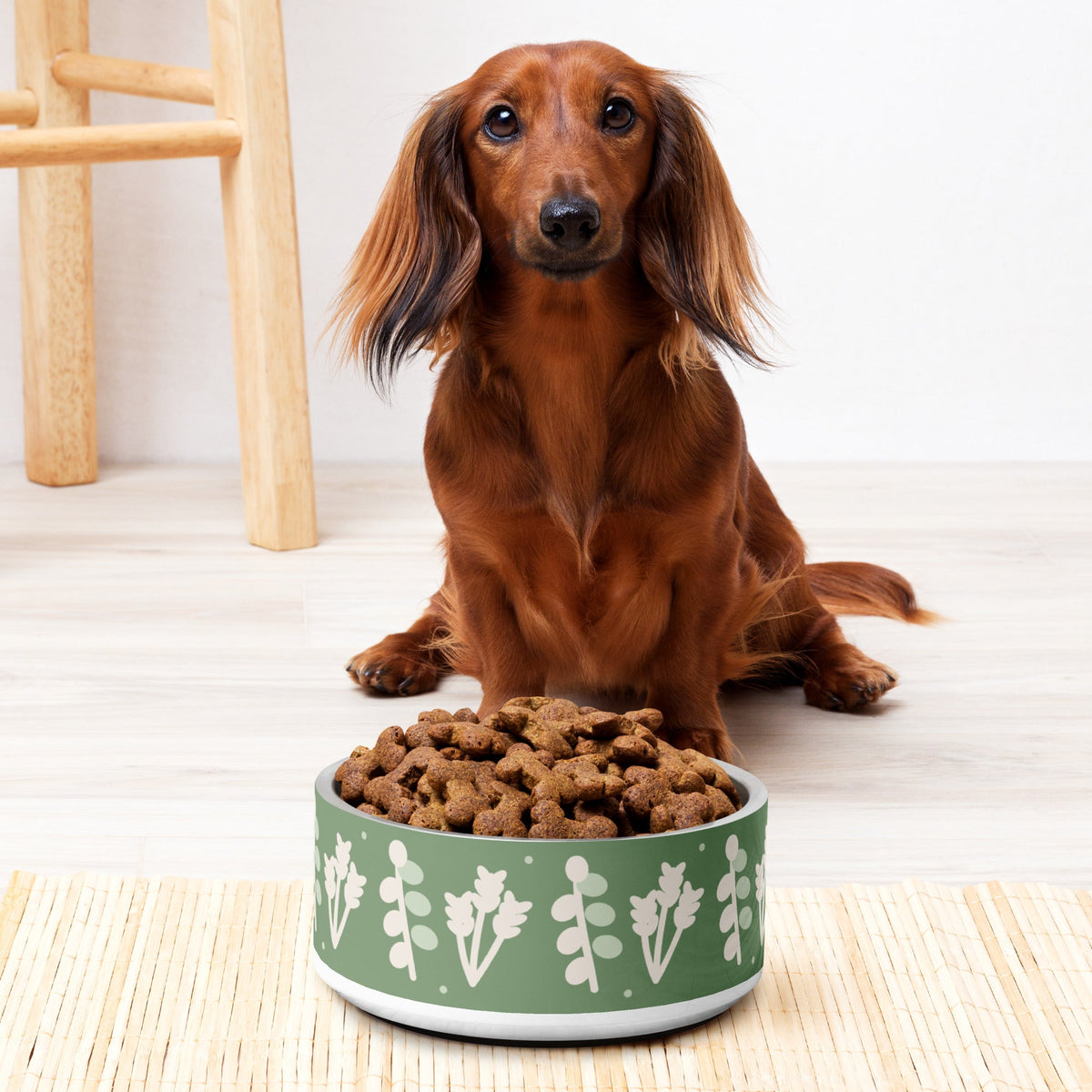
A spoonful of rice in the bowl seems harmless at first. But even a small side portion adds energy. For a healthy adult dog, softly cooked rice or potatoes can occasionally work as an extra. They should not generously replace the complete food, though.
Das Video dazu
Mit Klick lädst du das Video von YouTube. Dabei werden Daten an YouTube (Google) übertragen. Datenschutz
Three questions matter: Is the side suitable? How much energy does it provide? And how much room is left for it next to treats?
What can go in the bowl?
Prepare a small portion separately: cook rice until soft, peel potatoes and cook them through completely, then let both cool down. Serve them plain. Fried potatoes, fries, seasoned rice or mashed potatoes with butter are not a suitable base. Raw or green potatoes do not belong in the bowl. The American Kennel Club explains the risks of potatoes with veterinary input.
Be especially careful with onions, garlic and leeks in sauces, broths or leftovers: these ingredients are toxic to dogs. That is why “left over from lunch” is not a sufficient safety check. The WSAVA lists unsuitable ingredients and limits for extras.
Extras stay extras
The WSAVA recommends keeping treats and other extras below ten percent of the daily calorie intake. This includes foods from the kitchen. This limit applies to everything together, not to rice and rewards each on their own.
It is an upper limit for orientation, not a target you have to reach every day. If your dog happily eats his complete food, he does not need an extra portion of rice. You can also set aside part of the weighed daily ration as a training reward.
Rice is not a generally bad ingredient in dog food. The Tufts veterinary school explains that dogs can usually use nutrients from grains well. What matters is the whole ration. A spoonful of rice makes a food neither automatically better nor more complete.
Why feeding less is not automatically the whole solution
If a side is added regularly, its energy has to be taken into account in the daily amount. Simply always feeding extra can promote weight gain.
But a calorie calculation does not check complete nutrient supply. Less complete food also means fewer nutrients from that food. A larger amount of rice or potatoes does not replace them properly. How much the supply changes depends on the specific starting ration.
Chicken with rice is not a complete long-term diet either. Tufts explains the limits of such bland diets. If homemade food is meant to take over a larger share, have the whole ration calculated by a professional.
A worked example with room for rewards
Suppose 1,000 kcal a day has been set as the suitable daily energy for a dog. His side portion provides an estimated 60 kcal, the treats another 20 kcal. Together that is 80 kcal, so eight percent. That leaves 920 kcal for his main food.
The following energy densities are freely chosen example values, not figures for a specific product:
- Dry food with 380 kcal per 100 g: 920 ÷ 380 × 100 = about 242 g.
- Wet food with 100 kcal per 100 g: 920 ÷ 100 × 100 = 920 g.
In general: grams of main food = remaining kcal ÷ kcal per 100 g × 100.
The 1,000 kcal is not a recommendation for every dog of a certain weight. Needs and the right portion differ from animal to animal. The 60 kcal of the side is also an assumption for this example, not a fixed gram portion of rice.
Weighed cooked or weighed dry?
Rice absorbs water when cooked. That is why you cannot multiply the weight of a cooked portion by the calorie value for dry rice. Always note whether you weighed before or after cooking, and use matching figures.
Food tables give an orientation. They are not an exact proof of how much energy your individual dog gets from this preparation. So avoid seemingly millimetre-exact rations based on generic table values.
How our feeding calculator helps you
In the free feeding calculator you can enter weight, body shape, daily routine and the energy of your food. For dry or wet food you will find fields for sides. For rice and potatoes you can choose whether they were weighed cooked or raw. “Weighed raw” describes the time of weighing and is not a recommendation to feed raw potatoes.
Treats and chews are recorded separately. Explicitly choose “No” there if your dog gets none; otherwise enter them as specifically as possible. The calculator takes the estimated energy of the sides into account in the gram amount of the main food.
The result is a starting value. A calculated gram amount or a short note about supplements does not confirm that every self-assembled ration is balanced. Watch weight, body shape and tolerance; for health questions, your vet's practice can help.
Our short German-language video “Leckerlis zählen mit: So viel Futter braucht dein Hund wirklich” shows why rewards belong in the daily calculation. The portion and snack values mentioned there are examples, not universally valid amounts. For rice and potatoes, you proceed the same way: count the energy in instead of adding it on top.
Weigh instead of “a small handful”
Place the empty bowl on a kitchen scale and press tare. Weigh the main food, set the display to zero again and weigh the side separately on top. Also have the training portion ready so it does not disappear from the calculation over the course of the day.
If you already have a usable kitchen scale, it is usually enough. If you are looking for one, the Soehnle Page Compact 300 Slate is a suitable option for normal food portions: it has a tare function, a display in 1 g steps and a capacity of up to 5 kg including the bowl. This is confirmed by the manufacturer for this version; the slate version is item 61515.
Advertisement / affiliate link: View the Soehnle Page Compact 300 Slate on Amazon.
The glass surface belongs on a firm, level base. Clean it according to the instructions; the scale is not dishwasher safe. For very small amounts of medication or supplement powders, a normal kitchen scale is not a suitable dosing aid.
When to ask first
For puppies, pregnant or nursing dogs, illnesses, intolerances and veterinary-prescribed food, your vet's practice should judge which additions are suitable. This also applies if your dog is meant to lose weight or if you regularly want to replace larger parts of the meal with self-cooked ingredients.
A simple routine is enough for everyday life: choose a suitable side, record the cooked portion correctly, add up all extras and include them when calculating the main food amount. If in doubt, have the ration checked rather than adding more and more ingredients or powders.
Sources and notes
Expert sources: WSAVA “Feeding treats to your dog”, Tufts “Nutrition FAQs” and “Does My Pet Need a Bland Diet?”, AKC “Can Dogs Eat Potatoes?”. The sources are linked in the relevant sections. Research on 05.10.2026; worked examples are explicitly model assumptions. This article offers general orientation and does not replace an individual feeding plan.
Amazon affiliate notice: A purchase through the marked affiliate link may earn PrintMyPet a commission. Your purchase price stays the same; you do not pay more because of it. As an Amazon Associate I earn from qualifying purchases.
20% of our profit goes to animal welfare. You can find out more on our animal welfare page.


